

is a modern “crash-style” betting game where players do not spin reels or match symbols. Instead, the game is built around a rising multiplier that increases as a virtual plane takes off. The goal is simple: cash out before the plane flies away.
Unlike traditional Slots Games, Aviator focuses on timing, risk control, and decision-making rather than randomness alone. This makes it highly popular in India among users who prefer fast, dynamic gameplay experiences.
The gameplay is extremely minimal but psychologically intense. A multiplier starts at 1.00x and keeps increasing. The longer you wait, the higher the reward—but if the plane disappears before you cash out, you lose your stake.
Most platforms integrate Aviator into broader gaming ecosystems such as Rummy Modern, where it sits alongside other real-money formats.
A typical round lasts only a few seconds, making it one of the fastest real-time betting games available.
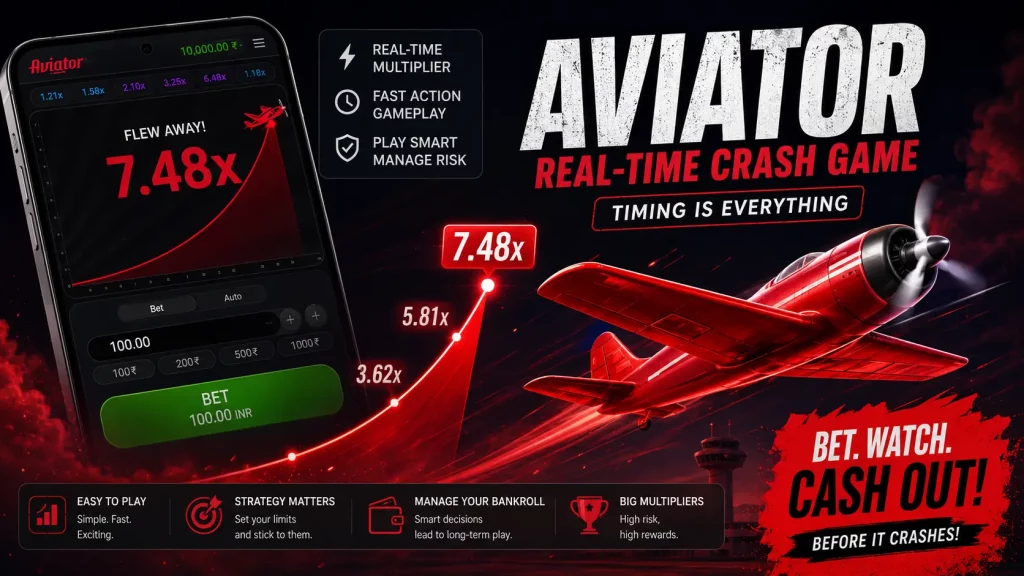
Core Gameplay Flow (Extended Version)
The core gameplay loop in Aviator is intentionally minimalistic, but each step carries a high level of psychological and strategic importance. The simplicity of the mechanics is what makes the experience so intense—every action happens in real time, with no delays, no pauses, and no second chances once the round develops.
1. Place your bet before the round starts
Before each round begins, players must decide how much they are willing to risk. This is the only phase where there is complete control without time pressure.
At this stage, decisions are typically influenced by:
- Bankroll size and session limits
- Risk tolerance (safe vs aggressive play style)
- Previous round outcomes (even though they don’t affect future results)
- Emotional state of the player
Once the round starts, the bet becomes fixed. There is no adjustment, no cancellation, and no way to increase control afterward. This is why preparation is often considered more important than reaction.
2. Watch the multiplier increase in real time
After the round begins, the multiplier starts rising instantly. This is the most visually engaging and emotionally intense phase of the game.
The multiplier increases smoothly and continuously, creating a sense of progression and opportunity. The longer the round continues, the higher the potential payout becomes—but also the higher the risk.
During this phase:
- Players observe rapid growth of potential winnings
- Emotional tension gradually increases
- The brain begins balancing greed vs caution
- Time perception often feels faster than reality
This is where most decisions become emotionally influenced rather than logically calculated.
3. Click “Cash Out” anytime
At any moment during the round, the player can choose to secure their winnings by pressing the cash-out button.
This is the most important decision point in the entire gameplay loop.
Key characteristics of this stage:
- Full control over exit timing
- Instant confirmation of winnings
- Ability to lock profits before crash occurs
- No guarantee of how long the multiplier will continue
Players often develop personal “exit strategies” such as fixed multipliers or reaction-based timing. However, even the best strategy must be executed under pressure, which makes consistency the real challenge.
4. If you wait too long → lose round instantly
If the player does not cash out before the random crash point, the round ends immediately and the entire stake is lost.
This is the defining risk mechanic of Aviator.
Important aspects:
- Crash happens unpredictably
- No warning is given before termination
- Delay of even a fraction of a second can result in loss
- Emotional hesitation is often the main cause of failure
This mechanic creates the core tension of the game: every second spent waiting increases potential reward but also increases the probability of total loss.
Risk vs Reward
| Cash Out Time | Multiplier | Risk Level |
|---|---|---|
| Very Early | 1.1x – 1.5x | Low Risk |
| Early | 1.5x – 3x | Medium |
| Mid Round | 3x – 10x | High Risk |
| Late | 10x+ | Very High Risk |
Multiplier Growth Curve
Aviator is not about predicting randomness. It is about controlling emotional timing under pressure. The game does not reward players for trying to “read” patterns or assume hidden signals in outcomes, because each round is designed to remain independent and unpredictable. Instead, the real skill emerges in how a player manages internal reactions in real time—especially when the multiplier is rising and every second creates a stronger temptation to wait just a little longer.
In practice, most decisions in Aviator happen within a very narrow emotional window. As the multiplier grows, the brain naturally starts shifting from rational planning to emotional anticipation. Players begin to feel the pressure of potential missed profit, and that pressure often becomes stronger than the original strategy they set before the round began. This is where discipline becomes more important than intuition.
Successful players treat each round as a controlled decision cycle rather than a guessing game. They define exit points in advance, or they build strict rules that prevent emotional deviation. This reduces the influence of fear and greed—two factors that are far more impactful than randomness itself.
Ultimately, Aviator tests consistency under uncertainty. The outcome of each round cannot be controlled, but the player’s timing, discipline, and emotional stability can be trained and refined over time.
Strategy Layers & Real-Time Decision Dynamics
Aviator is often perceived as a simple crash game, but under the surface it operates as a layered decision system where timing, perception, and behavioral control interact in real time. Each round creates a short but intense cycle of anticipation, evaluation, and reaction, where players continuously adjust their internal thresholds for risk and reward.
What makes the game engaging is not the multiplier itself, but how human decision-making behaves under constant upward pressure. As the multiplier grows, the perceived value of waiting increases, but so does the psychological cost of hesitation. This creates a natural tension between logic and emotion that repeats every round.
Key Behavioral Layers in Gameplay
- Perception Layer → Players interpret rising multipliers as opportunity signals
- Emotional Layer → Fear of missing out (FOMO) and greed intensify over time
- Decision Layer → Final cash-out timing is executed in milliseconds
- Feedback Layer → Outcome reinforces future behavior patterns
Risk Distribution in Player Behavior
Most players naturally fall into predictable behavioral categories:
- Early Exit Players → prioritize consistency over profit spikes
- Balanced Players → adapt based on recent outcomes
- High-Risk Players → chase rare high multipliers
- Reactive Players → decision depends on emotional state of the moment
These categories are not fixed; players often shift between them depending on streaks, losses, or confidence levels.
Player Behavior Breakdown
| Player Type | Cash-Out Style | Risk Level | Consistency |
|---|---|---|---|
| Early Exit | 1.2x – 2x | Low | High |
| Balanced Player | 2x – 5x | Medium | Medium |
| Aggressive Chaser | 5x – 20x | High | Low |
| Reactive Player | Varies | Unstable | Unpredictable |
Real-Time Pressure Mechanism
The core intensity of Aviator comes from a continuously increasing decision gap. At the beginning of each round, the optimal action window is wide and comfortable. As time passes, that window narrows rapidly.
This creates a psychological compression effect:
- Early seconds → logical thinking dominates
- Mid phase → mixed emotional and rational control
- Late phase → emotional reaction dominates
This shift is what causes most inconsistent decisions.
Decision Outcome Distribution
Interpretation of the Cycle (Extended Version)
The gameplay loop in Aviator is not a fixed pattern of actions—it is a continuously adaptive behavioral system. Every round functions as a small feedback experiment, where the outcome does not just represent win or loss, but actively reshapes how the player approaches the next decision.
Instead of operating independently, each round adds a psychological “layer” to the player’s internal model of timing. This model is constantly updated based on emotional impact, perceived missed opportunities, and previous outcomes. Over time, this creates a personal decision profile that can be either stable or increasingly volatile depending on how the player processes results.
How Reinforcement Actually Works
Each outcome influences future behavior in a subtle but powerful way:
- Winning early does not only increase confidence—it often reinforces a conservative exit pattern, encouraging players to lock profits quickly in future rounds.
- Missing high multipliers creates a strong psychological imprint, reinforcing patience and pushing the player to delay cash-out in later rounds.
- Losing late (after waiting too long) tends to generate the most important learning signal, but only if the player correctly interprets it as a discipline failure rather than “bad luck.”
The key point is that none of these reactions are purely logical. They are emotional learning responses shaped by intensity, timing, and memory bias.
The Formation of a Personal Risk Identity
As rounds accumulate, players gradually form what can be described as a “risk identity”—a stable but evolving behavioral pattern that defines how they react under pressure.
This identity is shaped by:
- Frequency of wins vs losses
- Emotional impact of extreme outcomes
- Personal tolerance for regret (missing profit vs losing stake)
- Reaction speed under uncertainty
Some players become naturally conservative over time, while others drift toward aggressive timing simply because emotionally charged wins or losses override rational planning.
Why Behavior Drift Happens
One of the most important dynamics in Aviator is behavioral drift—the gradual shift away from original strategy.
This happens because:
- Emotional memory is stronger than statistical reasoning
- Recent outcomes feel more important than long-term averages
- Rare high multipliers create disproportionate influence on decision-making
- Losses create urgency that distorts timing discipline
As a result, even players with strong initial strategies often slowly diverge from their own rules without realizing it.
Aviator is not simply a game of reaction—it is a structured environment for behavioral conditioning under uncertainty. Success does not come from anticipating outcomes, but from maintaining a consistent decision rule while emotional pressure continuously tries to override it.
The system repeatedly tests one core ability: whether a player can preserve timing discipline when every outcome in memory is actively trying to change it.
In the long run, the real competition is not against randomness, but against the gradual erosion of consistency caused by accumulated emotional experience.
Mobile Experience, Real-Time Flow & Platform Integration
Aviator’s real strength becomes most visible when it is experienced on mobile devices. Unlike traditional casino-style formats that rely on slower, multi-step interactions, this game is designed for continuous real-time engagement. Every element of the interface is optimized for speed, clarity, and immediate response, which is especially important in a game where milliseconds can influence the outcome.
On mobile platforms, the entire gameplay loop feels more intense because the screen space is limited and attention is fully concentrated on a single dynamic element—the rising multiplier. There are no distractions such as complex reels or multi-layered UI structures. This simplicity forces players to focus entirely on timing, which increases both engagement and emotional pressure.
The experience becomes even more responsive when optimized APK versions are used, as they often reduce input delay and improve animation stability. This difference might seem small at first, but in a game where reaction speed directly impacts results, even minor improvements in performance can significantly affect decision accuracy.
Real-Time Responsiveness as a Core Mechanic
Aviator is not just visually real-time—it is structurally real-time. Every action happens without delay:
- The multiplier updates continuously
- Cash-out actions are executed instantly
- Round transitions happen without loading screens
- No pause exists between risk and outcome
This uninterrupted flow creates a constant decision pressure. Unlike traditional formats where players have time to think between actions, here the thinking process must happen simultaneously with observation.
As a result, players often develop what can be described as “instant decision conditioning,” where choices are made before full conscious evaluation is completed. This is one of the key reasons why the game feels so fast-paced even though the rules themselves are extremely simple.
Mobile Optimization & User Behavior
On mobile devices, behavior tends to shift slightly compared to desktop users. The smaller interface naturally increases focus, but also increases impulsive reactions. Many players rely on quick taps rather than structured planning, which changes the rhythm of decision-making.
In practice, mobile users often experience:
- Faster reaction-based cash-outs
- Shorter average session duration
- Higher emotional engagement per round
- Increased reliance on auto-style habits over time
These patterns are not accidental—they are a direct result of interface design combined with real-time pressure mechanics.
Platform Integration Effects
When Aviator is integrated into larger ecosystems such as gaming hubs or reward-based platforms, its behavioral impact becomes even more noticeable. Systems like bonus structures, progression rewards, and cross-game incentives subtly influence how players approach risk.
For example, platforms that combine Aviator with Slots Games or reward loops tend to increase session continuity. Players are more likely to stay engaged across multiple rounds because each outcome feels connected to a larger system of progression rather than a single isolated event.
This creates a layered engagement model where:
- Short-term gameplay is driven by reaction timing
- Medium-term engagement is driven by rewards and bonuses
- Long-term retention is driven by system progression and incentives
Entry Points and User Flow
Most players do not start directly inside the game. Instead, they enter through structured access points such as promotions, onboarding flows, or referral systems. These entry mechanisms shape expectations before gameplay even begins.
Common access paths include:
Login Bonus offers that encourage first engagement, Sign up incentives that lower entry friction, APK installations for faster access, and navigation through game Links shared across platforms. Once inside the ecosystem, players typically move between multiple game types, including Aviator and other interactive formats, depending on available rewards and interest cycles.
Mobile vs Desktop Gameplay Behavior
| Factor | Mobile Experience | Desktop Experience | Impact on Gameplay |
|---|---|---|---|
| Reaction Speed | Very Fast (Tap-based) | Moderate (Click-based) | Mobile favors quick decisions |
| Focus Level | High concentration | Multi-tasking possible | Mobile increases immersion |
| Session Length | Short bursts | Long sessions | Desktop supports strategy thinking |
| Emotional Pressure | Higher intensity | More controlled | Mobile amplifies urgency |
What makes this phase of Aviator important is not the technical execution, but how environment shapes decision quality. Mobile design reduces friction, which increases speed—but also reduces thinking time. Desktop provides more stability, but slightly reduces emotional intensity.
Neither version is objectively better. Instead, they create different psychological conditions that influence how players develop timing habits and risk tolerance over time.
Aviator’s mobile experience transforms the game from a simple crash mechanic into a continuous decision stream. Every interaction is compressed into real-time action, where hesitation is not just a disadvantage—it is a defining factor of outcome variability.
The system does not ask players to predict what will happen next. Instead, it repeatedly tests how efficiently they can act within a shrinking window of certainty while maintaining control over impulse-driven decisions.
Aviator is not an isolated mini-game. In modern platforms, it functions as a behavioral engine inside a much larger gaming ecosystem. Its real value is not only in short gameplay sessions, but in how it contributes to long-term user engagement, retention cycles, and monetization structure.
Unlike traditional casino formats that depend mainly on static probability outcomes, Aviator creates continuous interaction loops. Each round is extremely short, but the repetition of rounds forms a long behavioral chain where engagement becomes self-sustaining. Players are not just participating in isolated bets—they are continuously interacting with a system that adapts to their activity patterns over time.
This is why Aviator is often positioned as a “core engagement product” within gaming platforms rather than just a standalone game. It generates consistent activity flow, which supports both monetization and retention mechanics.
How the Ecosystem Sustains Engagement
The structure behind Aviator relies on a combination of psychological reinforcement and system-driven incentives. Instead of forcing long sessions, the game encourages frequent returns. Each interaction is short, but the emotional impact is strong enough to influence future behavior.
What makes this system effective is that it does not rely on complexity. It relies on repetition and emotional memory. Every round leaves a trace—either positive (successful cash-out) or negative (missed opportunity or loss). These micro-experiences accumulate into long-term engagement patterns.
Over time, players begin to associate the game with rhythm rather than isolated results. This rhythm becomes the foundation of retention.
Reward Layer Integration
Modern platforms integrate multiple reward systems around Aviator to strengthen user motivation. These systems are not part of the core gameplay itself, but they influence how often and how long players engage.
Rewards typically operate across different layers:
- Immediate engagement incentives that encourage starting gameplay sessions
- Progress-based rewards that activate after repeated participation
- Event-driven incentives that create urgency during limited-time cycles
Each layer interacts with the others, forming a continuous loop where players feel rewarded not only for outcomes, but also for participation frequency.
This is particularly effective in fast-cycle games like Aviator, where session frequency is naturally high due to short round duration.
Long-Term Behavioral Reinforcement
As players continue interacting with the system, their behavior gradually shifts from reactive to pattern-based. However, these patterns are not always rational. Instead, they are shaped by emotional reinforcement over time.
For example, a player who experiences several early wins may become more conservative, believing that quick exits are optimal. Conversely, a player who misses several high multipliers may begin delaying cash-outs, even when it contradicts their previous strategy.
This gradual shift is not random—it is a natural result of feedback accumulation. The system does not explicitly teach behavior, but it constantly reinforces it through outcomes.
Over long periods, this leads to deeply personalized play styles that are difficult to reset or standardize.
Monetization Logic Behind the System
From a platform perspective, Aviator supports monetization through structural engagement rather than direct pressure. The game does not need to force long sessions or complex mechanics. Instead, it benefits from natural repetition cycles.
Each round represents a micro-transaction opportunity, but more importantly, it represents a decision event. Decision events are more valuable than passive gameplay because they require active participation, which increases emotional investment.
The result is a system where engagement and monetization are aligned. Players remain active because the experience is dynamic, while the platform benefits from sustained interaction volume.
Psychological Retention Cycle
Aviator’s retention model can be understood as a repeating loop of expectation and outcome. Each cycle slightly adjusts the player’s internal expectation threshold.
- Positive outcomes raise confidence and increase willingness to take risk
- Negative outcomes increase caution but may also increase urgency to recover losses
- Neutral outcomes reinforce consistency but do not significantly alter behavior
Over time, this cycle creates a personalized “decision fingerprint” for each player, shaped entirely by their history of interaction.
Aviator Monetization & Ecosystem Impact
| System Element | Function | Impact Level |
|---|---|---|
| Core Betting Cycle |
View DetailsEvery round creates a micro-decision event where players place bets and decide timing for cash-out. This generates constant engagement loops with extremely high interaction frequency. | Very High |
| Reward Systems (Bonuses) |
View DetailsLogin rewards, promotions, and progression bonuses increase retention and encourage repeated daily engagement, even outside active gameplay sessions. | High |
| Player Behavior Feedback |
View DetailsEach win or loss modifies future decision-making patterns. This creates adaptive behavior loops that increase long-term platform engagement. | Very High |
| Session Frequency Model |
View DetailsShort rounds encourage repeated sessions instead of long playtime, increasing total number of interactions per user per day. | High |
| Cross-Game Ecosystem (Slots / Games) |
View DetailsPlayers often move between Aviator, Slots Games, and other formats, increasing total platform retention and diversifying engagement patterns. | Medium |
| Referral & Links System |
View DetailsExternal Links and referral sharing bring new users into the ecosystem, expanding organic growth and reducing acquisition costs. | Medium |
Aviator ultimately operates as a structured behavioral system disguised as a simple crash game. Its real depth does not come from mechanics or visuals, but from the way it repeatedly compresses decision-making into short, emotionally charged moments.
Over time, the game becomes less about individual rounds and more about consistency across hundreds of micro-decisions. Players are continuously tested not on what they know, but on how reliably they can apply it under changing emotional pressure.
This is why long-term success in Aviator does not depend on prediction ability. It depends on whether a player can maintain stable timing discipline even when every previous outcome encourages deviation.
In this sense, the game is not just entertainment—it is a continuous feedback environment where behavior is shaped through repetition, pressure, and adaptation.
Aviator FAQ
What is Aviator game?
Aviator is a real-time crash game where a multiplier increases continuously until it suddenly stops. Players must cash out before the crash to secure winnings.
How do you win in Aviator?
You win by cashing out before the multiplier crashes. The higher the multiplier at cash-out, the bigger the payout, but also the higher the risk.
Is Aviator predictable?
No. Each round is independent and fully random. There are no patterns or guaranteed prediction methods.
What is the main skill in Aviator?
The main skill is timing control. Players must decide when to cash out under emotional pressure and uncertainty.
Why do players lose in Aviator?
Losses happen when players wait too long for higher multipliers and the crash happens before cash-out.
Can I play Aviator on mobile?
Yes, Aviator is fully optimized for mobile browsers and APK apps with real-time responsive gameplay.






Comments